A crew of AI agents. One human who signs off.
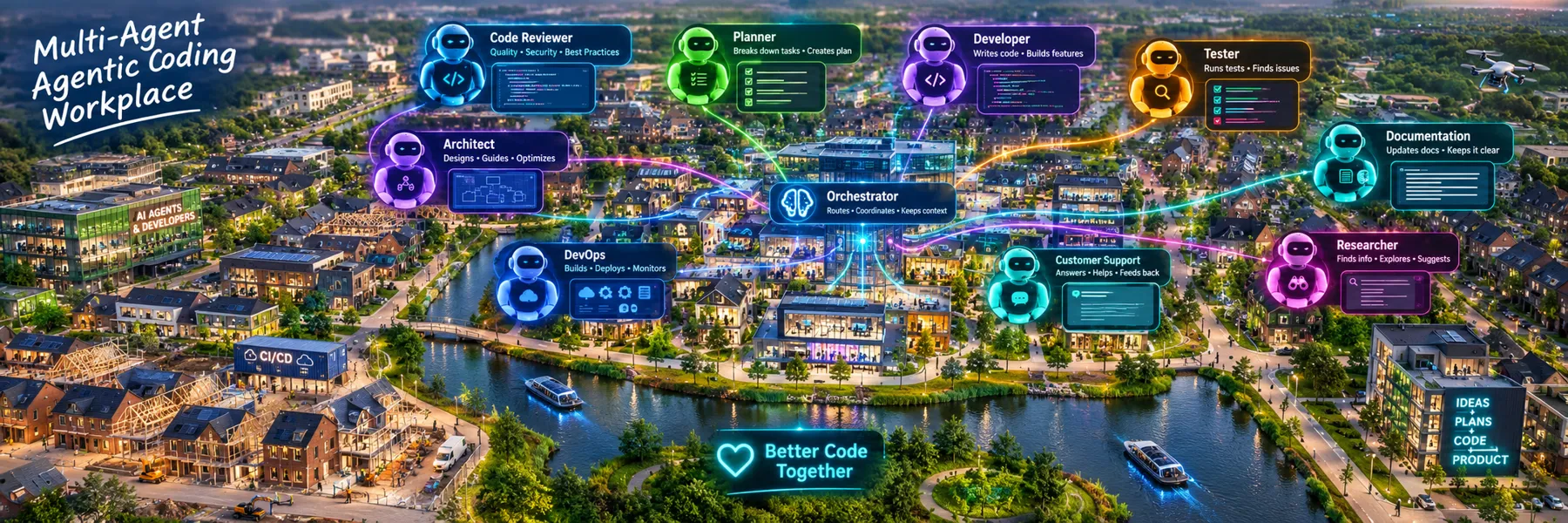
At 1Vision365 the daily development work runs on a crew of specialised agents. One builds, another reviews, others triage, release and document. A person decides what goes in, and a person merges it.
These are not generic bots pointed at the internet. Every agent is built on my own expertise and working method.






The agents know what I know.
An AI model on its own knows a little about everything. What makes this crew useful is the knowledge it is given: years of Business Central, AL and PrintVis experience, written down as instructions for every role.
My know-how, written down
Active in Navision, Dynamics NAV and Business Central since 2004. Patterns, pitfalls and product knowledge that normally live in one person's head are the briefing every agent starts from.
A role, a method, a checklist
Each agent gets instructions for its own job: how to write tests first, what a reviewer looks for, how a design is structured, when to stop and ask a person.
Models are the engine
Cloud and local models supply the language skills and the speed. The standards, the domain knowledge and the final judgment come from me, not from whatever a model found online.
Where the agents work, and where a person does.
Every support request follows the same path. Agents do the analysis and the building. People and plain scripts guard the hand-offs.
- Customer
Customer reports
Opens an issue in the public support repository: a question, a bug or a feature request.
- Human
We review
A person reads the report and accepts it. Nothing moves before that.
- Script
Bridge hands over
A plain script translates the report and creates a work item in the private app repository. No AI decides this.
- AI agent
Triage
An agent sorts it: ready for development, needs a design, or needs more input. For bugs, a second agent finds the root cause first.
- Human
We start the build
A person approves the work, and the design if there is one, and starts the build.
- AI agent
Tests first, then code
The developer agent writes the tests, makes them pass, runs the pre-PR checks and a compile, and opens a pull request that references the issue.
- AI agent
Independent review
A different agent gives a formal approve or request-changes, with the CI build as evidence. Branch protection requires it.
- HumanAI agent
We merge and release
A person merges and publishes. A docs agent updates the documentation, and the customer hears it is fixed in version X.
A question, not a bug
The support agent answers from the public documentation and the knowledge base. After three replies, or when unsure, the agent stops and a person takes over.
A feature that needs a design
The triage agent asks for a design, a design agent writes it, and a person approves it before building starts.
Thirteen agents, each with one job.
Every agent has a role, its own identity and a short list of things it may start.

Orchestrator
Workspace lead. Starts the specialists, runs the scheduled jobs and keeps the platform tidy.
AL coder
Writes the tests first, then the AL code that makes them pass, followed by pre-PR checks, a compile and a pull request that references the issue. Never merges.

C# / .NET coder
Builds Azure Functions and web apps in the same test-driven way. Every change goes to the reviewer.
Reviewer
Gives a formal approve or request-changes on every pull request, with the CI build as compile evidence. Never merges.
Root-cause analyst
Finds the cause of a bug and the approach to fix it. Read-only: writes nothing to GitHub.
Solution designer
Writes the design before a line of code is written, for features that need one.
Issue triage
Assesses new issues: ready for development, needs a design or needs more input. Writes no code.

Work-item triage
Triages incoming work items for customers on Azure DevOps and separates clear from unclear.

Release picker
Prepares release candidates for Azure DevOps customers, on its own branches and pull requests only.
Docs writer
After each release, updates the documentation and release notes in one docs pull request.

Support agent
Answers questions in the public support repository from the public docs. Stops after three replies, or when unsure.
Invoice import
Reads vendor invoices from mailboxes and pre-fills purchase invoices in Business Central for a person to check.

News digest
A daily watch on European tech startups that reduce US-tech dependency, delivered as a digest.
How the crew stays safe to work with.
Agents never merge
A person approves and merges every pull request. Review agents can approve, but they cannot press the button.
One identity, one sandbox
Every agent has its own GitHub identity, its own git branch and its own Docker sandbox, with access limited to its role.
Customer text is data
Text from issues and emails is untrusted input. Only maintainer notes count as instructions.
Scripts route, agents think
Polling, labelling and hand-offs are plain scripts that cost nothing when idle. A model is used only where judgment is needed.
Dry run first
Anything that writes to a customer-facing place runs as a dry run before the real thing.
A paper trail
Labels are switches and every step leaves a comment, so each fix can be followed from report to release.

Self-hosted, with the tools you already use.
- Platform
- A self-hosted multi-agent platform running on our own hardware
- Where it works
- GitHub, Azure DevOps, Microsoft Teams and Telegram
- Models
- Established cloud models, supported by locally running LLMs
- Isolation
- One git branch, one worktree and one Docker sandbox per agent
Curious how this would work for your project?
Send a short description. You get an answer from a person, who will also tell you honestly where an agent adds little.
info@1vision365.com